
As private-market investments come under greater scrutiny, attention has shifted beyond performance figures to the fundamentals of a strategy: how assets are valued, where returns are expected to come from and the risks investors are ultimately assuming.

For advisers considering a qualifying Business Relief investment, understanding the underlying assets and how they are valued is a key part of due diligence. Equally important is another question: as markets change, is the investment manager adapting its strategy and approach to keep pace with those changes? 

This is particularly relevant in real estate lending. Market conditions have changed materially in recent years, altering both the risks lenders need to consider and where we believe attractive lending opportunities can be found.

When the market changes, the lending decision changes

Historically, much of our development lending was focused on build-to-sell residential property, where repayment typically comes from selling the completed homes. Those opportunities still exist of course, but higher financing and construction costs, together with pressure on purchaser affordability reducing sales velocity, mean that the assumptions underpinning an individual development’s commercial viability require ever greater scrutiny and analysis

At the same time, we have seen more opportunities in developments where value is supported by operating income, including build-to-rent (BTR), purpose-built student accommodation (PBSA), co-living and selected commercial property.

These changes reflect changes in the wider market and economy. For example, CBRE* expects UK rental housing supply to remain constrained, while its office research team points to a shortage of Grade A space relative to occupier demand in parts of the market. Neither trend makes an individual investment attractive by default, but both can create opportunities for lenders prepared to examine the underlying transaction in detail.

At Ingenious, that changing opportunity set is visible in our own lending activity.

How the mix of new lending has changed

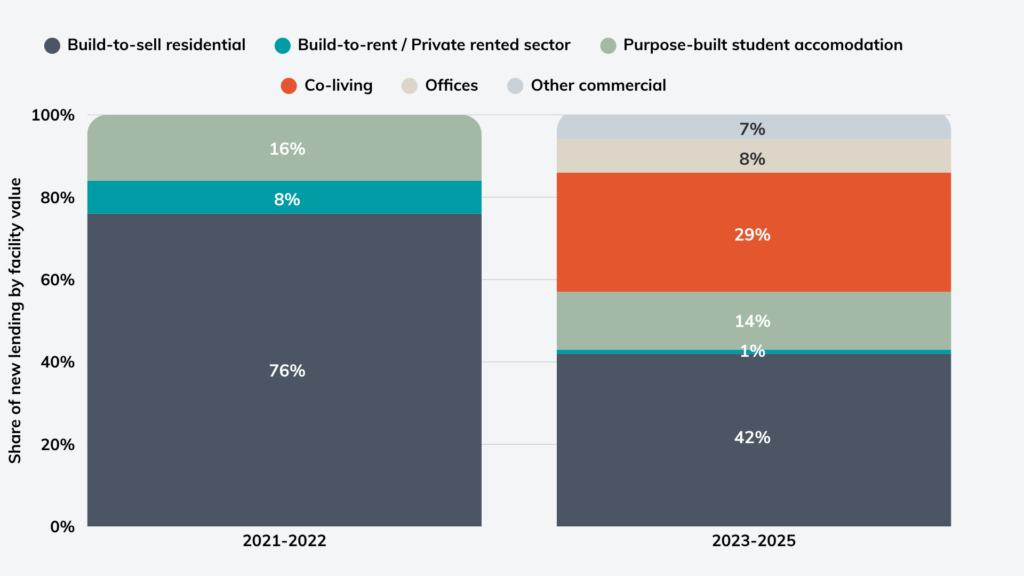
Source: Ingenious Real Estate internal lending data, 2021–2025. New loan originations only, measured by facility value at inception. Comparison based on aggregated lending for 2021- 2022 and 2023 – 2025.


Between 2021 and 2022, build-to-sell (BTS) residential developments accounted for approximately 76% of our new lending by facility value. Across 2023 to 2025, that proportion fell to 42%, with lending activity extending across a broader range of property types, including co-living, student accommodation and commercial developments.

This evolution reflects our willingness to consider different opportunities as market conditions change, rather than maintaining a fixed preference for one type of development. However, a broader lending mix does not, in itself, reduce investment risk. The quality of each individual opportunity, its underlying assumptions and its route to repayment remain central to our lending decisions.

Adapting doesn’t mean following the crowd

A change in market conditions does not mean replacing one favoured property sector with another.

BTR is not automatically attractive because rental demand is strong. PBSA is not automatically defensive because there is a shortage of student beds. Equally, an office development is not automatically unattractive because working patterns have changed.

For us, this means looking beyond the sector label to the borrower, location, business plan, cost of development and, critically, the proposed route to repayment. We also test the assumptions that are doing most of the work: what happens if completion is delayed, sales or lettings take longer, rents are lower or the eventual valuation is weaker than expected?

The interaction between those assumptions can matter more than any one measure in isolation.

Today, there is less room for a lender to be right about the sector but wrong about the individual deal.
– Dimitriy Williamson, Investment Director at Ingenious

Two opportunities, two different decisions

A recent PBSA opportunity illustrates the point. The location served three large universities, there was evidence of a shortage of student beds, and the developer had relevant experience. On the surface, there was a persuasive case for the sector and location.

However, our analysis suggested that the proposed exit yield and rental income was ambitious relative to the market evidence reviewed. Applying a more conservative assumption materially reduced the expected value of the completed development, which in turn increased leverage and weakened the proposed refinance route. The underlying demand for student accommodation remained, but the transaction no longer met our lending criteria.

We declined the opportunity.

By contrast, we were prepared to finance the refurbishment of a central London office into Grade A space despite the development being speculative, with no pre-lets.

In that case, our analysis of the specific location, supply of comparable Grade A space, recent transactions, sponsor experience and quality, and proposed route to exit supported the lending decision. Wider market evidence also points to constrained Grade A office supply, although this varies considerably by location and building quality.

The comparison is important because neither decision was driven by a view that PBSA is “good” or offices are “bad”. Instead, each decision reflected an assessment of the individual transaction, including the borrower’s experience and track record, the underlying assumptions and the proposed route to repayment.

Selection is only the start

Selecting where to lend matters because it establishes the risks investors are exposed to. But the real estate lending model also determines how value is derived and how those risks are managed once capital has been deployed.

For Ingenious, returns from lending are generated principally through contractual interest and fees payable by borrowers. This means the investment case does not depend solely on property prices rising.

The loans are typically secured by a first legal charge over the underlying property, providing security that can be enforced if a borrower defaults. Independent professional valuations twinned with the knowledge and understanding of comparable transactions, help inform our assessment of the property and lending position, while development projects are subject to ongoing professional monitoring.

Our team’s experience across different market cycles, including restructuring loans and enforcing security, when necessary, helps inform both our initial lending decisions and our response when borrowers encounter difficulties.

These are important characteristics of real estate-backed lending, but they should not be mistaken for guarantees. Property values can fall, borrowers can default and, if security must be enforced, the proceeds realised may be insufficient to repay a loan in full. Investor capital therefore remains at risk.

That is precisely why selection, structuring and monitoring need to work together.

(Image: Build to rent co-working space in Sheffield; development currently underway)

Governance continues after the loan is made

Our role does not end when a loan completes. Projects are monitored against the agreed business plan, with independent professional input used where appropriate. If costs, timings, sales, lettings or other assumptions begin to move away from plan, the objective is to identify that change early enough to assess what action may be required.

Experience from existing and previous loans also feeds back into future underwriting and monitoring. Where issues encountered on one project expose a risk that could arise elsewhere, we can amend the information we request or the way future facilities are structured.

This matters because the value of an experienced lender should not be judged solely by how many loans it has originated. It should also be evident in what it chooses not to fund, how it structures the opportunities it does select and how those loans are managed throughout their life.

What should advisers look for in a real estate lending manager?

For advisers assessing a real estate lending strategy, headline measures such as loan-to-value (LTV) remain useful, but they are only part of the picture.

A low LTV is useful, but ultimately loans are repaid with cash, not valuations.
– Dimitriy Williamson, Investment Director at Ingenious

While advisers will not typically have access to individual underwriting assessments, there are practical ways to evaluate an investment manager's approach through published information, due diligence materials and direct conversations.

An investment strategy that responds to change

Can the manager explain how its lending activity has evolved and why? Portfolio information, investment updates and commentary can help advisers understand how the manager responds to changing market conditions and whether its lending decisions remain consistent with its stated strategy.

Transparency about performance and risk

Does the manager provide meaningful information about its portfolio, performance and the risks investors face? Beyond headline returns, advisers should look for information on portfolio composition, lending performance and, where available, how loans that have encountered difficulties have been managed.

Clear governance and ongoing monitoring

Are there established processes for making investment decisions and overseeing loans throughout their life? Advisers should be able to understand who is responsible for lending decisions, whether independent valuations and professional monitoring are used, and how the manager identifies and responds to developments that could affect repayment.

Experience should be visible in the decisions

An investment manager’s experience should not be measured simply by how long it has been lending or the number of transactions it has completed. What matters is how that experience informs its approach as market conditions change.

For advisers, this means looking beyond headline performance and lending metrics to understand the thinking behind the strategy, the transparency of the information provided and the processes in place to manage risk. These are areas where an investment manager should be able to demonstrate its approach, rather than simply describe it.

At Ingenious, we believe experience should be evident in the opportunities we pursue, those we choose to decline and how we manage lending risks throughout the life of an investment.

Markets will continue to change. The question is whether an investment manager can demonstrate how it is responding.


Our investments are considered high risk and investment decisions regarding them should be made with careful consideration. The value of an investment may go down as well as up, and investors may not get back the full amount invested. Business Relief qualification is not guaranteed and depends on the Portfolio Companies continuing to carry on sufficient qualifying activity. Tax treatment depends on the individual circumstances of each client and may be subject to change in future. Ingenious does not provide financial or tax advice.

Ingenious Insights case studies

BR Planning After April 2026: Fix the AIM Gap

BR Planning After April 2026: Fix the AIM Gap

Read more
Manage Pension-related Inheritance Tax (IHT) Risks Using IEP Apex

Manage Pension-related Inheritance Tax (IHT) Risks Using IEP Apex

Read more
Business Relief & Post-Business Self Planning

Business Relief & Post-Business Self Planning

Read more
Business Relief & Power of Attorney

Business Relief & Power of Attorney

Read more

Have a question?

Get in touch with us!